
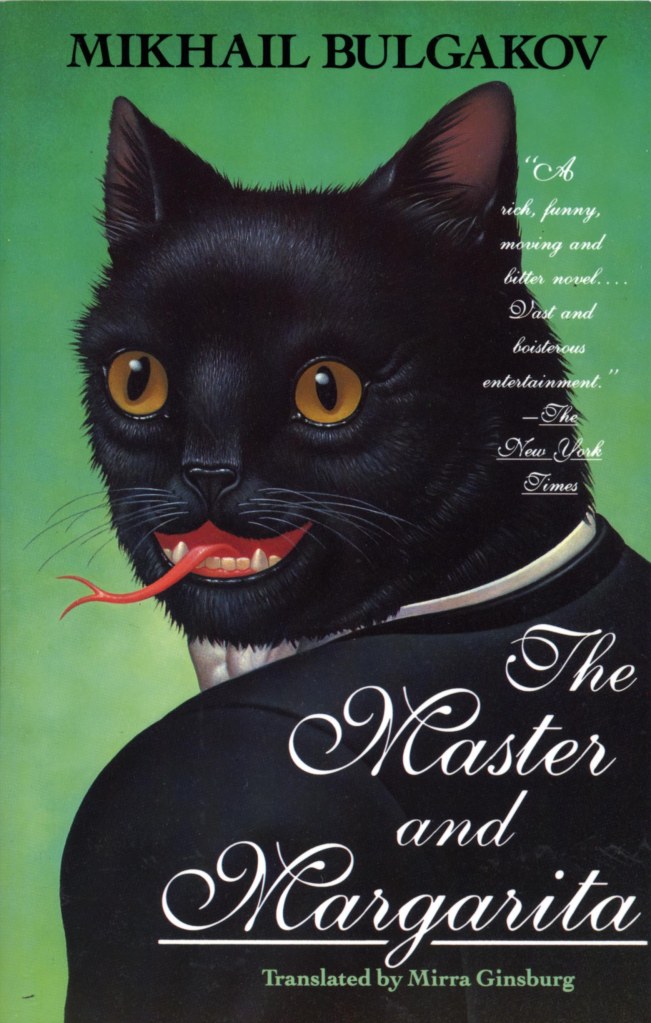
Last month I had the pleasure of reading Mikhail Bulgakov‘s The Master and Margarita for the very first time, and besides it making it to my list of books I would want to have if I were to be stranded on a deserted island, its also prompted me to dwell on the concepts of good and evil.
Although I know that might be a rather depressing reflection to make in light of the current state of the world, I feel that it is something that must be done when reading such a thought provoking novel. Now, I am by no means an academic, so it is very possible you won’t find this personal reflection to be enlightening or life changing in anyway, and that’s fine. But if it happens to also prompt you to meditate on these topics and perhaps even to read (or reread) the book, I will consider it my first literary success.
The novel starts with the following quote from Goethe‘s Faust:
“I am a part of that power which eternally desires evil and eternally does good.”
In my opinion, this quote sets the tone of the story and prepares us for the introduction of characters who, throughout the book will either question, suffer or joyfully partake in the matters of good and evil. Unfortunately, I have abstained from reading Faust until I can read it in its original language. Yet that did not stop me from putting down the book to fully digest this quote.
The concepts of good and evil are introduced to us very early on in life in the forms of stories, fairytales, and sometimes, religion. In fairytales and stories these concepts play out with the protagonists being good and the antagonists being evil, cue a decisive battle between the both and ultimately the protagonists’ triumph over the antagonists. If you had any exposure to religion growing up (specifically catholicism), then you would know that the Devil is the representation of evil while God is the representation of good. However, their battle doesn’t play out as it does in stories or fairytales, but is rather an ever ongoing power struggle transposed on humans. In a religious understanding, the Devil is evil and wishes to corrupt humanity with the sole objective of alienating them from God, or the ways of good.
And since religion is a big element in the Master and Margarita, I could only interpret this quote in connection to that religious understanding of good and evil. In this quote from Faust, we are aware that Mephistopheles is a demon and therefore represents evil, yet, by stating that he is “part of that power” and not the power himself, not only does he make a direct reference to that primordial power clash between good and evil, but he also recognises that he, just like the characters in the Master and Margarita, are just actors in something bigger than themselves.
Now, what could have Mephistopheles meant by when he said “part of that power”? I personally consider that he is referring to God, who although being a higher power, tends to avoid meddling into the affairs of men (at least directly). Again, if you grew up religious or had any exposure to it, you must have come across the question (either posed by you or someone else) of God’s reluctancy to use his power to fix the world. Which, in turn, questions the existence of God altogether.
Interestingly enough, Bulgakov prompts such a question in the story, with no less than having Woland, who is the Devil in disguise, ask the following question to his first victim:
“If there is no God, then who, one wonders is directing human life and all order on Earth in general?”
I personally consider this one of my favourite interactions in the book, not only because of the excellent dialogue but also because of the realisation that there is no good answer to this question. I paused here and thought to myself, if there is a God, then he does not seem to care much for the direction of human life nor the order of things considering the current state of the world. And if there isn’t a God, then that means that we have no direction and chaos is natural to our species. It means that, all this suffering is man-made, self inflicted, and that ultimately, we are the only ones that can change it. If those are the only two options we have, then funny enough, I would have to agree with the Devil on the existence of God.
Since this turned out a bit extensive and I still have other quote analysis I wish to share, this will be a two-part blog post. I would love to hear your thoughts on the book or this entry. Feel free to share your favourite quotes, characters or parts of the book as well!

 Writing is permanence
Leave a comment